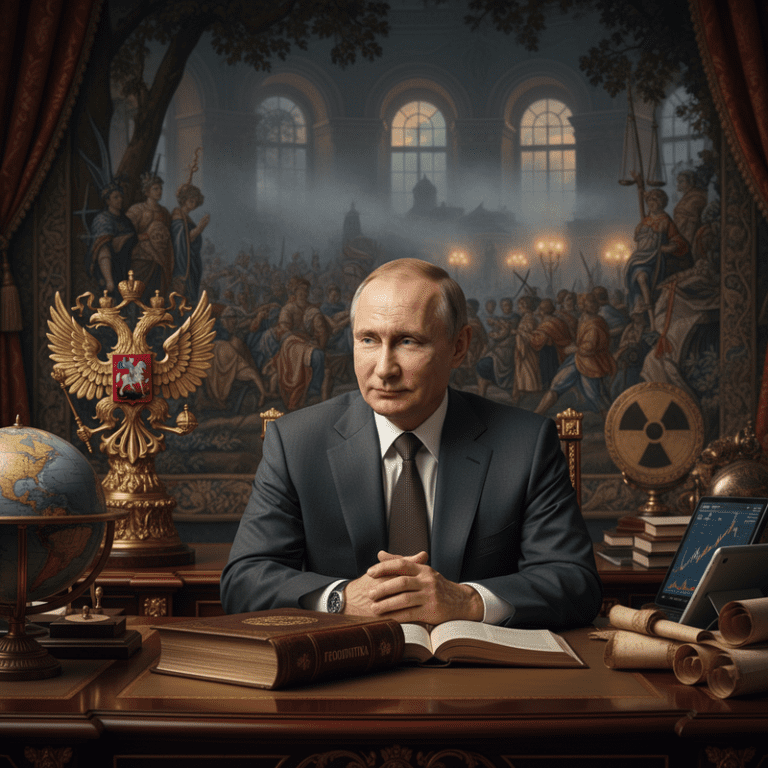
Vladimir Putin: A Portrait of Power and Paradox 🤔
In the ever-shifting landscape of global politics, Vladimir Putin stands as both a titan and a tempest, a figure whose presence evokes admiration, fear, and myriad contradictions. As the audacious president of Russia, he orchestrates a narrative as complex as a Russian nesting doll, revealing layers of national ambition, personal vendetta, and skilled political maneuvering. But what drives this enigmatic leader, and what can his recent actions tell us about the future of global politics? 🌍
The Iron Fist and Velvet Glove
Putin’s political career has been marked by striking contrasts, a study in antithesis. On one side, we perceive the iron fist—his steady centralization of power, suppression of dissent, and a palpable disregard for democratic norms. In 2020, constitutional amendments facilitated a potential lifetime presidency, illustrating his unyielding grip on the Kremlin.
Yet, beneath this authoritarian veneer lies a different narrative—the velvet glove. Putin presents himself as a champion of Russian sovereignty and a bulwark against Western imperialism, casting his reign as a righteous campaign to restore national pride after the disintegration experienced during the 1990s. This duality is as pronounced as a snow-covered Tula landscape juxtaposed against Moscow’s bustling sprawl.
Putin in the Public Eye: The Spectacle of Power
Like a figure from a Dostoevsky novel, Putin plays to the audience—projecting a carefully crafted image of virility and control. From judo lessons to bare-chested fishing trips, he crafts a persona that fuses the rugged individualism of a Russian hero with the authoritarianism of a tsar. While his shows of masculinity may seem trivial, they serve a deeper purpose: to forge a connection with the populace, reinforcing the idea that their leader is not just a man of power but a man of the people.
The Kremlin’s Shadow Games 🎭
While Putin’s theatricality appeals domestically, internationally, it elicits skepticism. From elections marred by fraud to aggressive foreign policies, his regime has been akin to a tightrope act, balancing on the edge of legitimacy and enmity. The annexation of Crimea in 2014 epitomizes this balance—radiating an aura of national rejuvenation while drawing widespread condemnation and sanctions from the West.
- The West: NATO expansion has become a convenient scapegoat, a narrative of encirclement that resonates with nationalistic fervor among Russians.
- Domestic Control: Through state-controlled media, dissent is painted as treason, distorting reality like a funhouse mirror, and creating an echo chamber of support.
- Geopolitical Chess: Each move in international relations resembles a game of chess, where he leverages energy exports, military might, and cyber operations as pawns in a broader strategic agenda.
The Enigma of Leadership: Vulnerability or Invincibility?
In a world where perceptions can be as crucial as reality, Putin’s vulnerability often lies concealed beneath layers of calculated invincibility. Yet, beneath the steely facade, one must wonder: could the gilded image he projects be merely a mask that obscures deeper insecurities? After all, the fear of losing power can lead even the most hardened leaders down a path of paranoia and retribution akin to that of a cornered animal.
The Economic Quicksand 💰
Economically, Russia finds itself entangled in a web of sanctions and global market shifts, resembling a dancer caught in quicksand—every step taken towards stability sinks the nation deeper into isolation. The reliance on energy exports as a lifeline has become precarious, especially with the planet’s pivot towards greener energy. As oil prices fluctuate, so too does Putin’s grip on power, a reminder that the currency of leadership is often dictated by resources rather than rhetoric.
Conclusion as a Question: The Future of Putin and Russia
The question lingers: What awaits Putin in the twilight of his reign? Will he adapt, like a chameleon amidst shifting political landscapes? The interplay between his power and the people’s will demonstrates a deeply human narrative of struggle, contradiction, and resilience that mirrors the broader dynamics of Russian society itself. 👀
Putting aside the irony of his championing “democracy” while short-circuiting its foundations, one must acknowledge that Putin’s story is still unfolding. The delicate balance of power that he navigates will determine not only his legacy but also the shape of future geopolitics in an increasingly fragmented world. In the end, will he be remembered as a master of strategy or a mere footnote in the annals of history? 🕰️